- Imprints:
- Oldcastle Books
- Kamera Books & Creative Essentials
- Pocket Essentials
- Crime & Mystery Club
- Pulp! The Classics
- High Stakes Sister Company:
- Verve Books
larger image »
UK RATES
Paperback
1 Pb: £3.00
Additional Pbs +£1.50/copy
Hardback
1 Hb £6.00
Additional Hbs +£4.00/copy
EUROPEAN UNION
Flat Rate:
£28.00/order
s
USA AND OTHER WORLD DESTINATIONS
Flat Rate:
£28.00/order
Publication Date:1 January 1970
Format: ebook(ePub)
Our Price:
ISBN:
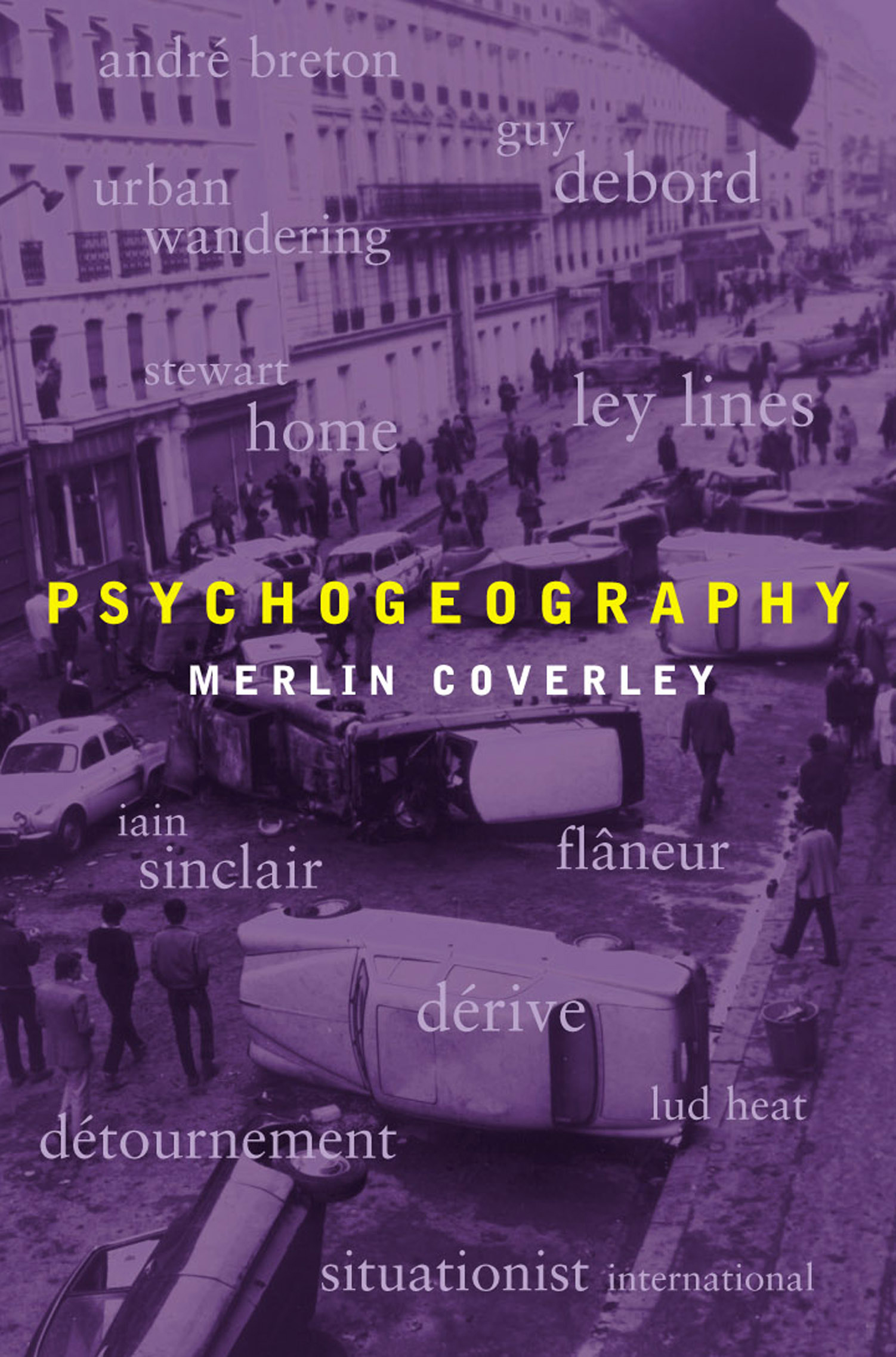
PSYCHOGEOGRAPHY
Merlin Coverley
Psychogeography. Increasingly this term is used to illustrate a bewildering array of ideas from ley lines and the occult, to urban walking and political radicalism. But where does it come from and what exactly does it mean?
Psychogeography is the point where psychology and geography meet in assessing the emotional and behavioural impact of urban space. The relationship between a city and its inhabitants is measured in two ways - firstly through an imaginative and literary response, secondly on foot through walking the city. PG creates a tradition of the writer as walker and has both a literary and a political component.
This book examines the origins of Psychogeography in the Situationist Movement of the 1950s, exploring the theoretical background and its political applications as well as the work of early practitioners such as Guy Debord and Raoul Vaneigem. Elsewhere, psychogeographic ideas continue to find retrospective validation in much earlier traditions from the visionary writing of William Blake and Thomas De Quincey to the rise of the flâneur on the streets of 19th century Paris and on through the avant-garde experimentation of the Surrealists. These precursors to Psychogeography are discussed here alongside their modern counterparts, for today these ideas hold greater currency than ever through the popularity of writers and filmmakers such as Iain Sinclair and Peter Ackroyd, Stewart Home and Patrick Keiller.
From Urban Wandering to the Society of the Spectacle, from the Dérive to Détournement, Psychogeography provides us with new ways of apprehending our surroundings, transforming the familiar streets of our everyday experience into something new and unexpected. This guide conducts the reader through this process, offering both an explanation and definition of the terms involved, an analysis of the key figures and their work as well as practical information on Psychogeographical groups and organisations.
Related material: The London Perambulator »
Read The Materialist Psychogeographic Affiliation first newsletter >> (PDF format)
Read The Scotsman on Sunday review >> (PDF format)
Or visit the Independent on Sunday site >> (online) for their review
Psychogeography - The Introduction - Audio File (mp3)
PRESS REVIEWS FOR Psychogeography
'A short book that offers an explanation and definition of this widely used term, and an analysis of the key figures and their work'
- Shaun Morris
'It's certainly a help with the inevitable question I face after giving a talk about anything: "what is psychogeography?" Now I can refer people to Merlin's book'
- Iain Sinclair
'Psychogeography, qu'est-ce que c'est? It's probably too late to be pondering this question now, as Merlin Coverley suggests in a new edition of his book of that title'
- A.T., Times Literary Supplement
'An excellent overview of a tradition that can be tricky to pin down and a great portal for loads of further reading'
- Hugh Marwood
'Although only 150-odd pages long, this is a complex book'
- John Rimmer, Magonia Review of Books
'Highly recommended'
- The Cauldron
'Psychogeography' was a term invented by the French philosopher Guy Debord, creator of the Situationist political movement and the concept of 'the society of the spectacle', in the 1950s. Debord defined it as 'the study of the specific effects of the geographical environment, consciously organised or not, on the emotion and behaviour of individuals' and he saw it in political terms as a way of transforming urban life and re-visioning the cityscape. Today, in the radical works of modern psychogeographers such as Peter Ackroyd, Iain Sinclair, Stewart Home and Peter Woodcock, the subject has now embraced the occult or hidden side of city and rural life, surrealism, the gothic, the visionary and the psychic. It also includes the study of ley lines or landscape alignments and sacred geometry, especially in cities such as London, Paris and Washington, ancient sacred sites, and an awareness of the geni loci or 'spirit of place', often subconsciously revealed in the design of buildings, open spaces and public artworks. Psychogeography provides the urban traveller and the rural wanderer with new ways of comprehending and understanding their surroundings and the environment. It transforms everyday experience into a spiritual or psychic quest and provides a chance to find something new and unexpected in what on the surface appears to be only the mundane. Highly recommended.
'This succinct book is a definite first port of call for anyone interested in this most esoteric of theories. A portmanteau of information, a pin-pointing of Psychogeography's literary impact and standing, and a stimulating read - it is a book that should be considered'
- Lee Rourke, 3:AM Magazine
'The word psychogeography has become common coinage; well, at least in London literary circles. Merlin Coverley informs us that the word was first used by the Letterist group (forerunners to the Situationist International), in Paris in the 1950s. But no one seems sure exactly what it means. In the introduction, the author asks, "Are we talking about a predominantly literary movement or a political strategy, a series of new age ideas or a set of avant-garde practices?"'
- Jah Wobble, Independent on Sunday
'This little book does exactly what an introduction should; it examines, explains, and whets the appetite...It has an extensive bibliography and an index of websites, research into which has been clearly and cogently utilised. It is a short, but valuable, book'
- Niall Griffiths, The Telegraph
'Now Merlin Coverley has written a short guide to psychogeography for beginners. It traces a line from English metrographers such as Daniel Defoe, through Thomas De Quincey and Arthur Machen, right up to Iain Sinclair. It also examines the emergence of the flaneur, and in so doing not only offers thumbnail sketches of some of the writings of Poe and Baudelaire, but suggests that psychogeography is a mode of urban counter-surveillance largely restricted to Paris and London'
- Sukhdev Sandhu, New Statesman
'It would be a fitting tribute to Coverley's unfussy and informative book if it encouraged people in other cities to try psychogeography'
- Stuart Kelly, Scotland On Sunday
AUTHOR LINKS
Find new perspectives through psychogeography. Or not. (wausaudailyherald.com)


